
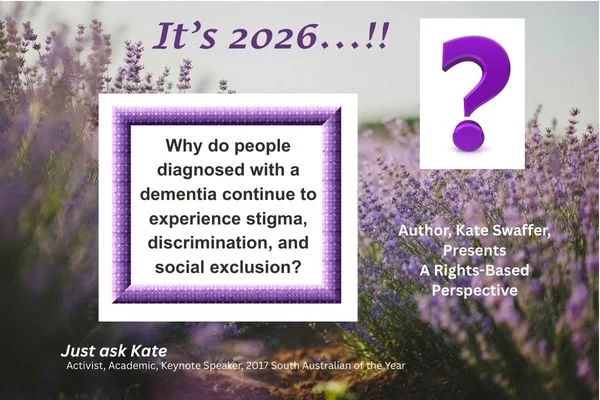
Author: Kate Swaffer © 2026
Despite decades of research, and public awareness efforts — including the widespread proliferation of the non-inclusive dementia-friendly campaigns— people diagnosed with a dementia continue to experience pervasive issues including stigma, structural discrimination, and social exclusion. These outcomes persist not because of a lack of awareness per se. They persist primarily because such campaigns fail to meaningfully challenge the underlying ableist and biomedical frameworks that shape public, institutional, biomedical and legal responses to dementia.
Critically, they also fail to recognise dementia as a disability— thereby excluding people with dementia from the legal and moral protections afforded under the United Nations Convention on the Rights of Persons with Disabilities (UNCRPD).
The UNCRPD mandates that all persons with disabilities, including those with cognitive and psychosocial diswabilities, are entitled to full legal capacity, autonomy, and participation on an equal basis with others.
Moreover, stigma is often perpetuated through benevolent othering, in which people with dementia are portrayed as needing compassion, protection, and charity rather than equality and justice.
While seemingly well-intentioned, such framings infantilise people with dementia and contribute to paternalistic practices that override their preferences, silence dissent, and limit their autonomy. These dynamics are reinforced through the dementia-[un]friendly campaigns that 1) do not employ people with dementia, and 2) that focus on community kindness and awareness rather than structural reform or accountability mechanisms.
A useful comparative lens can be found in audism, a term used to describe discrimination against Deaf people and the privileging of normative communication modes, and a pervasive form of oppression.
Like audism, dementia-related stigma and discrimination are often rooted in the devaluation of non-normative communication, memory, or processing styles. Just as Deaf individuals have historically been denied full legal and cultural recognition due to their divergence from dominant auditory norms, people with dementia are similarly oppressed, and frequently excluded from employment, decision-making, governance, and legal agency due to perceived cognitive difference.
This epistemic injustice contributes to their ongoing invisibility within both the disability rights movement and mainstream human rights discourse.
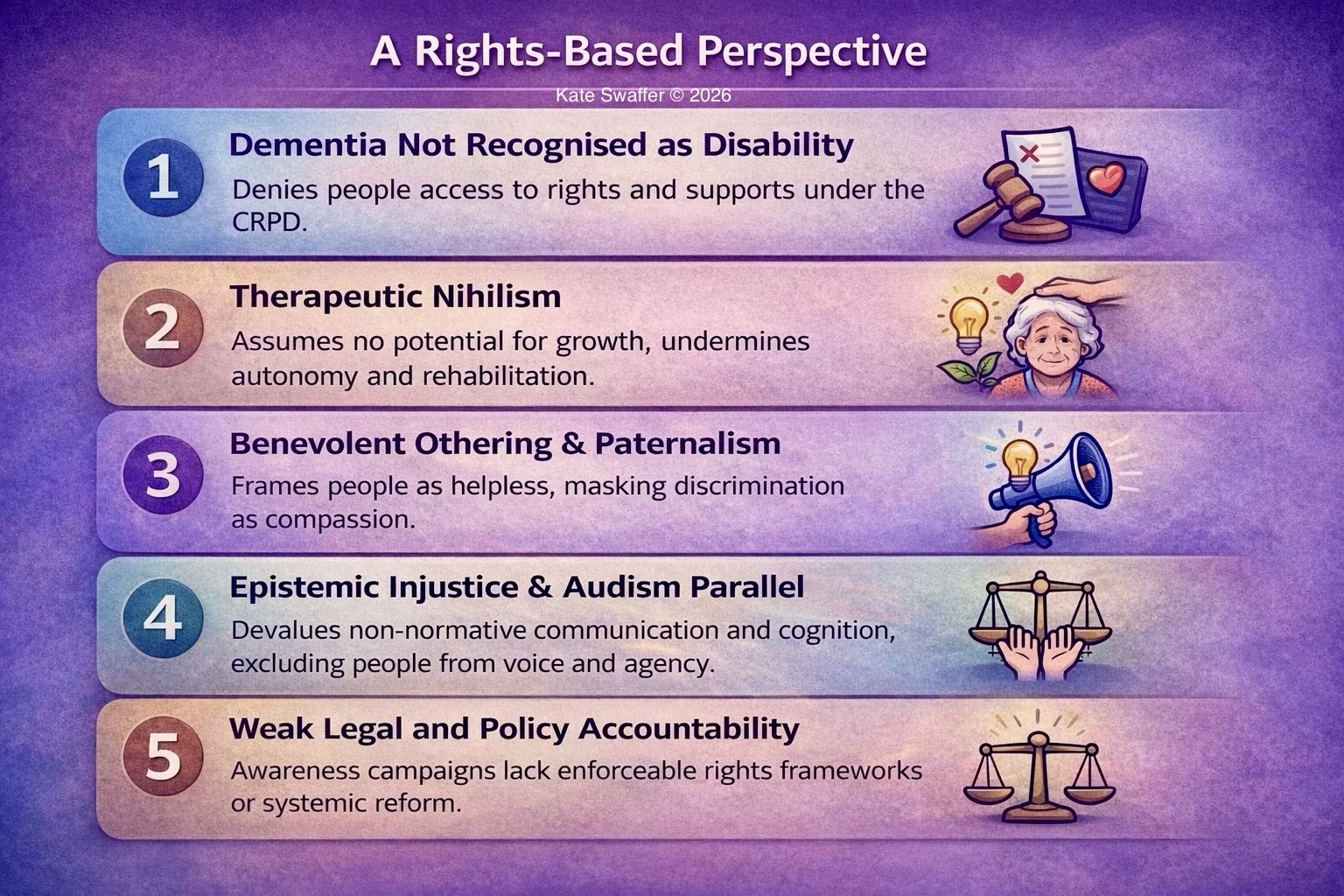
Ultimately, the continued discrimination against people with dementia stems from the failure of current awareness models to centre rights, justice, and disability recognition. A shift is required—from awareness to accountability, from compassionate benevolence to equality, and from symbolic inclusion to legal empowerment.
Embedding CRPD-aligned principles—such as supported decision-making, reasonable accommodations, and non-discrimination—within health, legal, and social systems is essential to dismantling stigma and ensuring that people with dementia are no longer excluded from full citizenship.
Whilstever people with dementia are not advised the symptoms of dementia are acquired progressive disabilities, they are also being denied the right to a full suite of personalised disability supports, to equal access to the CRPD. Hence it is crucial to provide all of the information about a diagnosis of dementia, and proactive, early disability support which includes reasonable accomodations to live independently and participate in society, and which include supports that assist people to maintain their overall health, mobility and inclusion in society for much longer than they are currently advised, or is expected.
Welcome to 2026…
Author:

Kate Swaffer (she/her) Kaurna Country Activist, Academic, Keynote Speaker, 2017 South Australian of the Year
Posted by:

Susan Troyer
Website Author & Curator
Leave A Comment