In American Dementia – Brain Health in an Unhealthy Society, published in 2021, Daniel George and Peter Whitehouse invite us to look beyond the biology of Alzheimer’s and ask a harder question: What if dementia is not only a medical condition, but also a cultural mirror? What if the stress, fragmentation, inequity, and relentless pace of American life are shaping our brains in ways we have been unwilling to confront?
When I first read this book in 2021, I felt “seen.” As a daughter walking alongside both parents following their diagnoses (1997-2012), we had come together with the intention of living our best lives in an alternative setting. Indeed, it was a rather idyllic setting in which we lived well with the support of a caring team. (See Welcome.)
Historically speaking – a daughter’s perspective
The period from 1970 to 1980 is now widely considered the “frontier years” for Alzheimer’s disease research and Big Pharma within the biomedical community. I first heard the name, “Alzheimer’s,” in 1980 when visiting a medical unit to speak with a clinician in one of my hospitals. When a patient approached her to ask a question and then turned to walk away, the clinician told me he had a “new diagnosis.” She called him by his name which I still remember! Strange as it seems now, I knew of no one with the diagnosis of Alzheimer’s or dementia while I was living and working in my high-rise Chicago apartment in the years which followed.
It was 1997 when Dad called to inform me of Mother’s diagnosis. Tragically, no one – no family member – was present with her in the physician office when the medical diagnosis was presented to my mother. She was given a pharmaceutical prescription but this was never monitored.
With boots on the ground following Dad’s cry for help in late 1998, I knew of no one with whom to consult about Alzheimer’s care in a non-nursing setting. So, from this point, we took a common sense approach. A physician consultation ended with agreement to terminate the “state of the art” medication for Alzheimer’s. Voila! The long period of nausea was over by the following day.
Thus, we began with medicine drops of liquids followed soon by chicken noodle soup. Within a few days, my father was pleased to be in the kitchen preparing milkshakes for her. She had not “lost” her appetite. Thus, our food-as-medicine approach began! Within four months, she regained the weight which she had lost in the previous year.
Looking back, it’s now significant to me, Google was not officially launched until 1998.
So what could possibly go wrong?
It took two moves within the following two year period – including their living in a retirement community for ten months – while I returned to Chicago and took a position with a consulting firm. Their stay in the retirement apartment with 24-hour caregivers was not sustainable – and the available options were “grim.”
Arriving at what became our long-term home, the alternative path we chose seemed to be “novelty” to our community, friends, colleagues – and myself!
A spirit of collaboration with my parents, an ability to be a “guide on the side,” a sense of gratitude about being together – and a caring team to work with us…! These were critical as we ventured into this important final stage of life. Did anyone in the heartland have any special preparation for this role – one which would provide support for desiring to live our best lives with dignity? They were simply not candidates for separation into two separate lifeless units, both designated for “Alzheimer’s” with ultra-sterile semi-private rooms.
Personally, I was certain something larger was at play when I first arrived back in my hometown. But who could have predicted our culture’s sharp decline over the subsequent years and the abandonment of our core values? If my parents were to be treated as they were treated, they surely needed an advocate at their side. Even as their adult daughter with a POA designation and experience in medical center and hospital administration, I sometimes felt invisible. A captive along with my aging parents! So this is how you are treated when you are “old”…!?
What follows is part of my ongoing reflection about “American Dementia” in which we are challenged to look at dementia through “a new lens.” According to these thought leaders, our cultural story of Alzheimer’s was being “powerfully produced.”
Challenging the “war on Alzheimer’s”
The authors challenged the dominant “war on Alzheimer’s” narrative and instead suggested that our national obsession with productivity, individualism, and competition may be eroding the very cognitive and social foundations that sustain brain health.
Their argument is not anti-science. Rather, it was a call for a broader science — one that includes sociology, environment, public policy, community design, and moral imagination. They question why we focus almost exclusively on pharmaceutical breakthroughs while neglecting chronic stress, social isolation, environmental toxins, educational inequities, and economic instability — all of which profoundly affect the brain over a lifetime.
The book reframes Alzheimer’s as part of a much larger story about how we live. If we design a society that exhausts, divides, and overstimulates its citizens, why are we surprised when neurological conditions arise? Chronic stress is not just emotional strain; it becomes biological wear and tear. The body and brain absorb it. Over decades, that accumulation matters.
“Mirror, Mirror 2024” ranks US healthcare systems
I digress from the Whitehouse-George publication to include the Commonwealth Fund’s most recent report, “Mirror, Mirror 2024,” which compares the performance of health systems in ten progressive countries. The results tell the story. Comparing healthcare system performance in ten nations, the US ranks #10 (out of 10) in “overall performance,” “access to care,” and “health outcomes.” It ranks #9 on “administrative efficiency” and “equity.” See additional rankings here.
It’s not a pretty reflection. One must search to the very bottom of almost every graph in the report for the US ranking in numerous categories. Just how did we get here?
An invitation to cultural self-examination
What struck me most deeply about this publication was the authors’ courage. They are not offering easy solutions. They are inviting cultural self-examination. They ask us to consider that dementia may reflect not only aging neurons but aging social systems — systems that prize growth over rest, speed over reflection, and consumption over connection.
The articulation of this perspective felt strangely relieving and affirming of what I had long considered. It shifted the conversation from blame and fear to responsibility and possibility – very similar to my response following our family’s diagnosis.
If culture contributes to cognitive decline, then culture can also promote cognitive resilience. Communities can be built differently. Policies can be shaped differently. Values can be recalibrated.
An urgent quest for soul in an age of American dementia
We have witnessed how essential it was to lift the veil of stigma over cancer, mental health, autism, disability, and more. Confronting the diagnosis of dementia with a sense of curiosity and awe rather than objectification and labeling is also a key to understanding and acceptance. Isn’t that what we would want significant others to do for us?
These two respected academic researchers – Daniel George and Peter Whitehouse – conclude that one’s brain health is always affected by the health of the society in which one lives. That conclusion helps in understanding the association between stress, dementia, and what we are witnessing today in American culture.
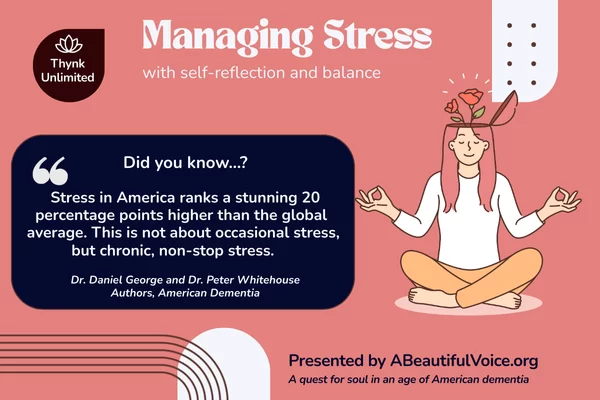
The stress graphic I created for this post highlights one thread in this larger tapestry: the cost of sustained stress to our brain health. It is not a small footnote. It is central. If we want to talk about brain health, we must talk about how we live — individually and collectively.
This book did not receive the attention it deserved when it was released. But its questions feel even more urgent today. Perhaps the conversation about dementia must expand beyond plaques and proteins and into the heart of our shared cultural story.
Sources:
Book title:
George, Daniel, PhD, MSc & Whitehouse, Peter, MD, PhD (2021) American Dementia – Brain Health in an Unhealthy Society. Johns Hopkins University Press.
My review:
American Dementia – Reflections, highlights, and ruminations from a daughter’s perspective (2022) https://abeautifulvoice.org/2022/11/02/american-dementia-reflections-highlights-and-ruminations-from-a-daughters-perspective/
Author:
Susan Troyer
Website Author & Curator
Member:
Leave A Comment