
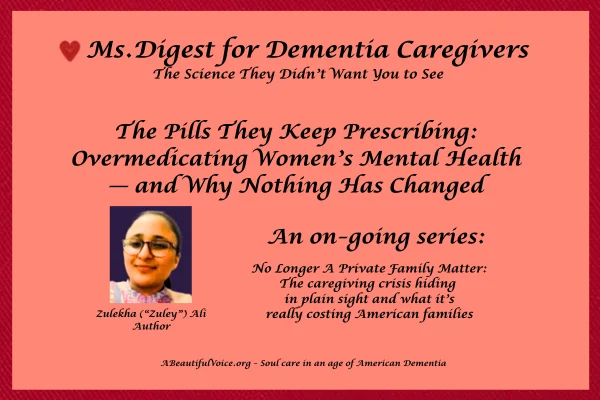
There is a moment in every overmedicated woman’s story when the prescription pad comes out before the conversation begins. The appointment is fifteen minutes. The chart has a score. The waiting room is full. The woman sitting in the chair has lost her mother, or her marriage, or her sense of who she is — and what she receives is a bottle of pills and a follow-up in six weeks.
That image stopped me mid-thought. Not because it was shocking, but because it was familiar. Because millions of American women are living inside that sentence right now — quietly, without complaint, without being asked what happened to them, and without any real acknowledgment from the systems that were supposed to help. We have all been told, in one way or another, that women’s distress is best treated with a prescription.
It is not. It never was. But we have built an entire healthcare system on the assumption that it is — and on the deeper assumption that a fifteen-minute medication check is the same thing as care.
Three Headlines, One Drug Class
Three stories dominated the news in recent weeks. A young mother in Massachusetts stands trial after her three children were strangled to death. She had been given thirteen different psychiatric medications in four months. A famous actress dies suddenly at thirty-six; a redacted list of prescriptions was found at the scene. A global pop icon admits she was taking near-fatal doses of Valium for years just to get through the day.
Lindsay Clancy was prescribed Ativan. Hayden Panettiere was prescribed Klonopin. Céline Dion was given Valium. All three are benzodiazepines.
This is not an isolated pattern. It is a systemic one — and it is gendered.
The Arithmetic Nobody Says Out Loud
Women are prescribed benzodiazepines at nearly twice the rate of men. In Spain, 67% of all benzodiazepine packages are prescribed to women, primarily for insomnia (52%) and anxiety (51%). Among women over 65, 53% are consuming them inappropriately.
According to the CDC, women (15.3%) are more than twice as likely as men (7.4%) to take medication for depression. A 2025 study in the Journal of Clinical Psychopharmacology found that psychotropic polypharmacy — being on multiple psychiatric drugs at once — is significantly higher in women than in men across all ages, including premenopausal, perimenopausal, and postmenopausal women.
The prescribing cascade is documented: benzodiazepine → antipsychotic has a prevalence of 3.2% in older adults — one additional antipsychotic prescription for every 242 patients.
These are not statistics. They are the arithmetic of a system that has decided women’s distress is best treated with a prescription.
How One Pill Becomes Five
The mechanism is well-documented. A stressful life event — postpartum insomnia, a panic attack, a death in the family — leads to a short course of a benzodiazepine plus an SSRI. The brain downregulates its GABA receptors. Tolerance develops. Between doses, the patient experiences agitation, heart racing, terror. She returns to the doctor.
The doctor misreads withdrawal as worsening anxiety. An antipsychotic is added. Then a mood stabilizer. Then a sedating antidepressant. Suddenly she is on five drugs, and no one knows which one is causing which symptom.
The chemical imbalance theory that justified this cascade has been discredited. A UCL-led review published in Molecular Psychiatry found “no convincing evidence that depression is caused by serotonin abnormalities, particularly by lower levels of or reduced activity of serotonin.” As lead author Professor Joanna Moncrieff put it: “The popularity of the ‘chemical imbalance’ theory of depression has coincided with a huge increase in the use of antidepressants.”
What This Means for Families
This is where the story becomes personal. Not in the headlines — in the homes.
In 1998, my mother was prescribed Aricept, the most common Alzheimer’s treatment on the market. For thirteen months, she was nauseated. She stopped eating. My father took her back to the doctor — again and again! The doctor kept prescribing. The side effect — anorexia— was in the fine print of the four-color ads in magazines like Time.
My mother survived, but many were not so lucky.
The caregiver absorbs the consequences — the relocation back to my hometown to support my father in identifying the cause of the nausea – and continuing on as her primary caregiver, leaving behind a lifestyle carved out over many years. The missed work, the sleepless nights, the financial drain, the isolation. Women caregivers in their late forties lose an average of $324,044 over their lifetime in wages, reduced Social Security, and retirement savings. Overmedicated women become care recipients, and the women who care for them absorb the consequences privately.
This is not a private family matter. It never was.
A Federal Priority — But Still the Wrong Question
In May 2026, HHS Secretary Robert F. Kennedy Jr. launched the MAHA Action Plan to curb psychiatric overprescribing and “drive deprescribing when clinically indicated.” He said: “We will support patient autonomy, require informed consent and shared decision-making, and shift the standard of care toward prevention, transparency, and a more holistic approach to mental health.”
But the questions I raised in 2015 — when I commissioned three articles on stress, dependency, and overprescribing for my physician consulting website — remain unanswered. Why have decades of documentation failed to produce system-wide change? Why do we still reward 15-minute medication checks over listening?
The policy has shifted. The system has not.
Partnership, Not Prescriptions
Riane Eisler’s partnership model offers an alternative: “Because there is no need to maintain rigid rankings of control, there is also no built-in need for abuse.”
Talk therapy has been proven as effective as antidepressants for treating depression. A 2015 systematic review and meta-analysis published in the BMJ found no substantial differences in short-term efficacy between cognitive behavioral therapy and second-generation antidepressants in the initial treatment of major depressive disorder. Alternatives exist: bioidentical hormones, omega-3s, probiotics, 5-HTP, L-theanine, B vitamins, listening.
But the system reimburses prescriptions, not presence. It rewards the fifteen-minute medication check, not the conversation.
What We Owe the Women Who Care
Caregivers deserve truth, accountability, and a system that treats them as infrastructure. Human suffering is not a design flaw. Grief, anxiety, and sadness are natural human responses to a hard world.
What if it’s time to start listening to what our body and our emotional pain are trying to tell us? What would we build differently if human well-being, rather than profit, were placed at the center?
Sources:
CDC National Health Interview Survey
Journal of Clinical Psychopharmacology, September 2025
Annals of Family Medicine, 2025
UCL-led review, Molecular Psychiatry
HHS Press Release, May 4, 2026
Riane Eisler, Nurture, Nature, and Caring;
Johann Hari, Lost Connections
Robert Whitaker, Anatomy of an Epidemic
Laura Delano, Unshrunk
Author:


Leave A Comment