
Somewhere tonight, a daughter is learning to insert a feeding tube using YouTube. Her mother, who once taught her how to tie her shoelaces, no longer recognizes her face. The home health aide hasn’t shown up in three days.
That image stopped me mid-scroll. Not because it was shocking, but because it was true. Because millions of American families are living inside that sentence right now — quietly, without complaint, without support, and without any real acknowledgment from the systems that were supposed to catch them. We have all been told, in one way or another, that caregiving is a private family matter.
It is not. It never was. But we have built an entire healthcare system on the assumption that it is — and on the deeper assumption that someone’s daughter will always be available. It’s about the emotional weight of being handed a situation where every option feels wrong, and yet doing nothing is unthinkable. That is the reality so many daughters, and sons, live with.
The Arithmetic Nobody Says Out Loud
Here is the math that no one in Washington wants to say out loud — and that most families don’t see coming until it is already too late.
For the first time in American history, there will soon be more people over 65 than under 18. The fertility rate has collapsed from 3.5 children per woman in 1962 to just 1.6 today — the lowest in recorded history. What does that mean in practice? Between you and your partner, that is potentially four aging parents to care for, and maybe one sibling to share the weight. The arithmetic of care has become impossible.
Geography has made it harder still. One in three older adults now lives alone, and the median American lives 30 miles from their nearest family member. The old assumptions — large families, shorter lifespans, women’s labor freely available and freely given — no longer hold. But the policies built on those assumptions have never been revised to reflect the world we actually live in.
The workforce shortage makes the picture even starker. The U.S. needs 1.2 million more direct-care workers by 2030. Already, 700,000 people sit on waitlists for Medicaid home care, with some states posting wait times that stretch an entire decade. The system is not strained. It is broken.
“Our entire economic and policy infrastructure was built for an earlier time.” That time is gone. The policies stayed. And we are still pretending this is a problem families can solve on their own.
What “Private” Actually Costs
Let us talk about money — because this is where the silence does the most damage, and where the real weight of “private” becomes impossible to ignore.
The national median cost of 24/7 in-home care in 2026 is $34 per hour. That is $24,733 per month. Nearly $297,000 per year. And that is for one parent — not two.
Medicare does not cover it. Medicaid will not either, for most families. Private long-term care insurance, when it exists at all, rarely covers round-the-clock care for an extended period. The assumption quietly built into every layer of the system is that someone’s daughter will absorb the gap — unpaid, untrained, and grateful for the chance to serve.
The scale of what families absorb is almost incomprehensible. Family caregivers collectively provide $1.01 trillion in unpaid labor every single year — a figure that exceeds total Medicaid spending and all out-of-pocket health spending combined. Fifty-nine million Americans are providing this care right now. And yet it appears nowhere in our economic indicators, nowhere in our policy conversations, and nowhere in the systems we have built to measure what matters.
At the individual level, the toll is just as staggering. Women caregivers in their late forties lose an average of $324,044 over their lifetime — in wages, reduced Social Security, and retirement savings they may never fully rebuild. One researcher documented her own personal outlay for caring for two parents over four years: $300,000. That is not a statistic. That is a life sentence handed down without a trial.
And that may still be an undercount. At a 2009 presentation, Gail Sheehy — author of Passages in Caregiving — put it this way: “Count on an outlay of $1,000,000 over a 10-year period.” She was speaking of one care recipient. One decade. One family.
For too long, this financial reality has felt like something to carry quietly — absorbed alone, without sibling support, without institutional backup, and without any public reckoning. Many caregivers never speak about it, even after it is over. I understand why. The silence is not just personal. It is structural. The caregiver becomes, by design, a caricature without a name and a voice — invisible to the systems she holds together. That invisibility is not accidental. It is the point.
Why We Still Call This Personal
So why does this remain invisible? Why, in the face of a trillion-dollar crisis affecting 63 million Americans, do we still treat caregiving as something families simply handle?
The answer starts with how we measure value. If unpaid care work were counted in GDP, it would represent between 20 and 50 percent of the entire economy. It is not counted — not by accident, but by design. Our conventional economic models fail to value the most essential human work. This is not a question of competition. It is a question of cooperation. The market measures what it chooses to reward. For half a century, it has chosen not to reward care.
The gendered dimension of that choice is not subtle. Women provide 61 percent of all unpaid caregiving in this country. They are the appointment schedulers, medication managers, financial coordinators, and emotional anchors — performing work that sustains the entire care system while remaining invisible in every economic measure that actually shapes policy. The triple role of worker, mother, and caregiver is not simply demanding. It is unsustainable without structural change.
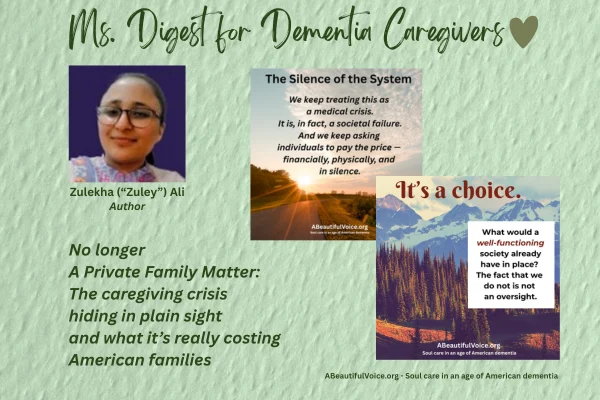
The deeper diagnosis is this: society itself suffers from what two leading researchers have called “cultural dementia” — a condition rooted not in biology but in the retreat from social democracy since 1970, when caregiving was medicalized, privatized, and reframed as the individual’s problem to solve. Big pharma’s Alzheimer’s drug failure rate through the 21st century stands at 99.9 percent. We keep treating this as a medical crisis. It is, in fact, a societal failure. And we keep asking individual families to pay the price — financially, physically, and in silence.
“How can we create a more caring economy for everyone?” That question is no longer rhetorical. It is the only one that matters.
No Longer a Private Family Matter
There is a second image that has stayed with me. A grown adult, crying in a parking lot — not because their loved one had died, but because they had realized they could not keep caregiving for another week. The caregiver is the second patient. Nobody in the healthcare system measures caregiver wellbeing. Nobody asks how we are doing. That invisibility at the personal level mirrors the invisibility at the policy level. They are the same failure, operating at different scales.
We talk about infrastructure when bridges fail. We do not talk about it when families do. But the bridges are falling — and they are made of human beings.
Caregiving is infrastructure. It is long past time we started treating it that way — not simply because it is the compassionate choice, though it is, but because the math has become impossible without structural change.
To honor the millions of families holding up a system that was never designed with them in mind, we must:
- Treat caregiving as essential infrastructure with real, sustained federal investment
- Build a national caregiving workforce pipeline — training, credentials, and care-specific pathways
- Fund home-based care support to meaningfully relieve the strain on family caregivers
- Give family caregivers Social Security credits, stipends, and portable benefits
- Ask caregivers how they are doing — not just how their loved one is
These are not radical demands. They are what any functioning society would already have in place. The fact that we do not is not an oversight. It is a choice. And we have made that choice, generation after generation, for half a century.
“Ultimately, improving brain health will require substantial changes in how we are governed, how we care for one another, and the investments we make in one another.” That is not just the closing argument of a landmark book on dementia and society. It is the only honest answer to the crisis we are living through right now.
Somewhere tonight, another family is learning that this was never supposed to be their problem alone.


Leave A Comment