
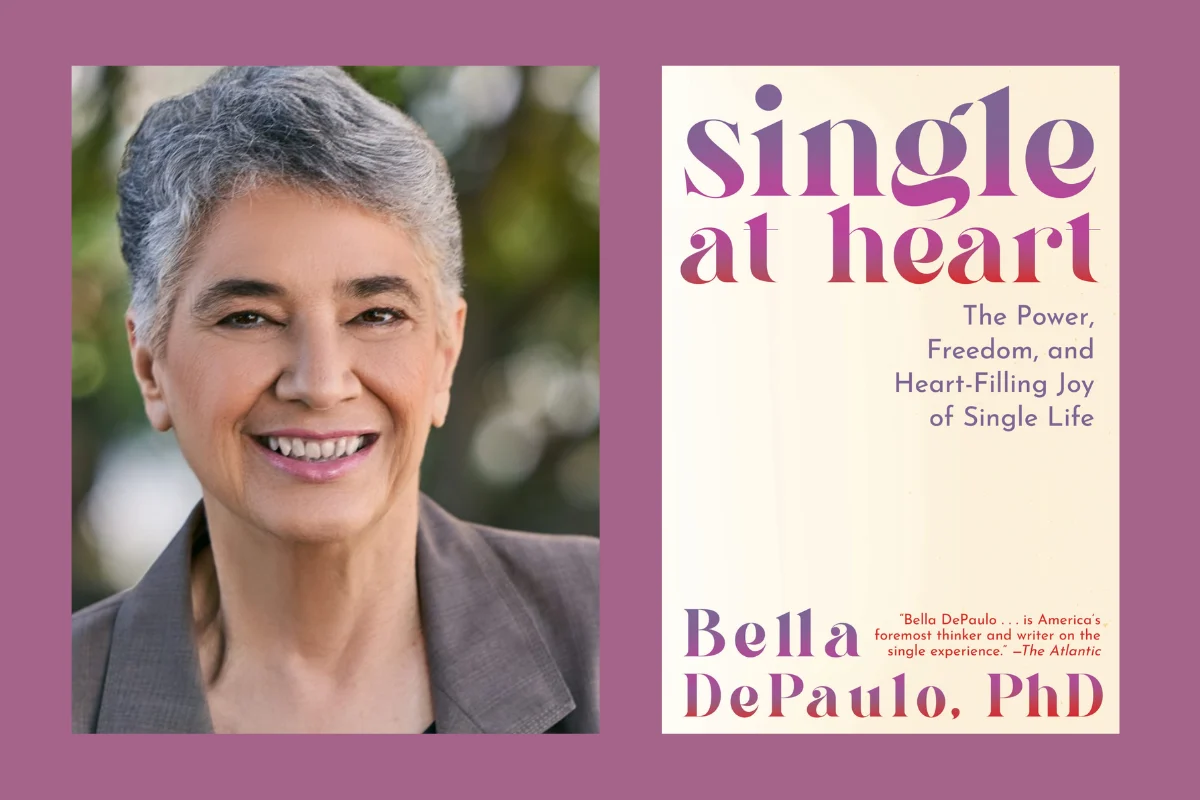
Bella DePaulo, PhD, agreed to help us set the stage and lead the conversation for our series of interviews on the topic, “No Longer a Private Family Matter: Conversations with professionals transformed by family caregiving.” She is a social scientist, author, blogger, teacher, speaker, and consultant who has authored and co-authored over 20 books.
Dr. DePaulo has a BA from Vassar College and a PhD from Harvard University. She has lectured nationally and internationally. After two decades as a professor of psychology at the University of Virginia, Dr. DePaulo moved to the West Coast, where she is currently an academic affiliate in the Department of Psychological and Brain Sciences at the University of California, Santa Barbara.
She is the leading expert on single life and has been described by The Atlantic as “America’s foremost thinker and writer on the single experience.” She coined the terms, “singlism” and “single at heart.”
She is prolific in her publications and presentations and has a remarkable website to showcase it all! Her work is definitely not to be missed!
Introduction
Q – For readers unfamiliar with your work, would you briefly introduce yourself and share what led you to devote your career to studying and naming singlism?
A – I’m 72, I have been single all my life and I always will be. That’s because single life is my most fulfilling life. I’m happy and flourishing because I am single, not in spite of it. I call people like me “single at heart,” and my most recent book goes by that title (Single at Heart).
As much as I love what single life has to offer (e.g., autonomy, solitude, the option to nurture bonds with as many people as I like rather than focusing on “The One”), I also started to notice the ways in which I seemed to be treated differently just because I was single. For example, at my first university job, my coupled colleagues would socialize with other couples on the weekends and not invite me; when a job candidate visited, they would expect me to cover the times no one else wanted; the person who arranged the teaching schedule asked me to teach at night because it would be “too hard” for the married faculty – and that was before any of them had kids! Outside of the university, I noticed that coupled people often paid less per person for things like memberships, subscriptions, entertainment, and insurance. Basically, I was subsidizing them by paying full price! Those observations and many others like them were the beginnings of my awareness of what I would later call “singlism,” the stereotyping, stigmatizing, and marginalizing of single people, and the discrimination against them.
I started asking other single people if they thought there were ways in which they were treated differently just because they were single – and wow, did they ever! That’s when I knew this wasn’t just something about me and that other single people really cared about this. That led to the publication of my first book, Singled Out: How Singles Are Stereotyped, Stigmatized, and Ignored, and Still Live Happily Ever After.
Before I wrote that book, I had no idea of the much more substantial ways in which single people were treated unfairly – for example, in their access to affordable health insurance (they have less) and in the Social Security system – the benefits earned by my married colleagues go to their spouse when they die; mine go back into the system! I can’t give them to someone who matters to me, such as a lifelong friend.
I have spent the last three or so decades of my life studying single people, advocating for them, doing research, writing books, writing for audiences beyond academia (e.g., my “Living Single” blog at Psychology Today), doing media interviews, and giving talks (such as my TEDx talk, that has been viewed more than 1.8 million times) and lectures. You can learn more about me here.
Personal Experience
Q – During your mother’s final months, what did that experience teach you about caregiving, family relationships, or social expectations that you could not have learned through research alone?
A – My mother was dying of pancreatic cancer. There was nothing more that could be done for her, medically. She was living nearly 400 miles away from me, in Pennsylvania. I was a college professor at the University of Virginia. Fortunately, I have siblings and they all wanted to help, even though none of us lived nearby. We created a schedule so that someone would be with my mom at all times. When it was my turn to be there, I felt grateful that I could be there with her, but it was also heartbreaking. It felt like death because, well, it was about death. When it was time to leave, I felt relieved. But then, after a short time, I missed her so much, and I wanted to be there so badly that I would return before it was my turn. I had no sense of that powerful emotional push and pull just from research.
When she died and I returned to the university after the funeral, some of my friends were wonderful. But other colleagues seemed completely clueless. They expected me to jump right back into all the committees and miscellaneous work of university life without skipping a beat.
I remember a graduate student telling me how upset he was that something was stolen from his car. He is a wonderful, kind person. I guess he was just too young to understand. In my mind I was thinking (but did not say, of course), “You lost an item from your car? My mother just died!”
Defining the Problem
Q – You coined the term “singlism.” How does singlism show up in family caregiving, particularly when aging parents begin needing support?
A – Singlism is the stereotyping, stigmatizing, and marginalizing of single people, and the discrimination against them. The most relevant stereotype of single people when it comes to family caregiving is that single people “don’t have a life.” That’s the derogatory belief that if you do not have a romantic partner, you don’t have anyone at all, and you have nothing important to do in your life. From that comes the unfair assumption that if aging parents need help, it is their grown children who are single who should show up for them – because, it is assumed, they don’t have a life. They aren’t going to miss out on anything important by being there to care for their parents. And in fact, research shows that when aging parents need help, they are more likely to get it from their grown children who are single than from those who are coupled.
I want to say something important about this whole issue. Some single people really want to be there for their aging parents. I found examples of that in my research with people who are single at heart (single life is their best life – their most meaningful and fulfilling life). For example, a 65-year-old who cared for his father during the last few years of his life when he had Alzheimer’s said, “It was an honor to help him.”
The problem comes when other people think that single people should be the ones to care for their parents because of derogatory assumptions like the one about how single people don’t have a life. Even the single people who do want to be there for their parents do not want to be regarded in that way.
The “Available Person”
Q – In many families, an unmarried son or daughter is often viewed as the “available” person—the one expected to step forward. Why does that assumption persist, and what are its consequences?
A – Until recently, there was little pushback against singlism. The idea that single people should be the ones to do the caregiving because they didn’t have anything else important to do – that wasn’t seen as a stereotype or an unfair assumption; it was just seen as the way things really were. Any single person who wanted to resist that assumption would probably get little support; instead, they would be accused of being selfish. The main consequence is that caregiving is allocated unfairly. That unfairness may also stir resentments. I think things are starting to change now. There are more and more single people, in many places all around the world. And there is growing awareness of the unfair ways single people are treated. More single people + more awareness = resistance to unfair practices and assumptions. Or at least I hope that equation is true!
Family Dynamics
Q – When caregiving responsibilities become unevenly distributed among siblings, what cultural assumptions often influence who is expected to help—and who is excused from helping?
A – The usual assumptions that single people don’t have a life and also that they don’t have anyone – or not anyone who counts. The irony is that single people may be the most vulnerable financially; if they need to take time off from work to care for a parent (or anyone else), they do not have a spouse to pick up the financial slack. Their financial resources are getting drained.
The Invisible Caregiver
Q – Many caregivers describe feeling invisible, taken for granted, or isolated. To what extent do those experiences reflect broader cultural assumptions about whose time, relationships, and lives are considered valuable?
A – I think single people who are caregivers are especially likely to feel that they are taken for granted. What they sacrifice by becoming a dedicated caregiver is likely to go unrecognized or discounted – again, because single lives are devalued and so are the important people in their lives such as their friends.
Public Understanding
Q – What do employers, healthcare systems, policymakers, and the general public still fail to understand about caregiving today?
A – Probably that it is costly, not just financially but also emotionally. The financial burden is especially heavy for single people who typically have only their own income. The financial burden may be especially problematic for single men, who are typically paid a lot less than married men, even when their records are the same.
Looking Ahead
Q – As our population ages and more people remain single throughout their lives, what conversations should we be having now that we are not having yet?
A – Care for the aging in the US is in terrible shape. It is way too expensive and finding caregivers to hire may become increasingly challenging, especially if the cruel immigration policies continue. The care of the aging is expected to be covered by people such as family members, for free.
That can be a challenge to potential caregivers of any marital or romantic relationship status, but it is likely to be especially challenging to single people (for the reasons I’ve already discussed). We need to be talking about this. We also need to talk about innovations in living arrangements beyond nursing homes and varieties of assisted living. I’m thinking of things like the village model (not the villages in
Florida!) and Green Houses.
Closing
Q – What potential good do you hope might come from bringing these caregiving realities—and the issue of singlism—into greater public awareness?
A – Of course, it will help single people if other people recognize that their lives matter just as much as anyone else’s, as do the people in their lives. Understanding what single people give up by doing so much of the work of caring matters too.
It has been a longstanding goal of mine to bring singlism into public awareness – in the domain of caregiving as well as many others as well (the workplace, the marketplace, places of worship, etc.). When these issues are broadly recognized, then the burden isn’t solely on the individual single person to try to explain to other people why they should not be expected to do a disproportionate share of the work of caring.
I think we will also have better quality of care for the people who need it when caregivers of all marital statuses and romantic relationship statuses are equally valued and appreciated.
Thank you, Bella, for your generosity of spirit, wisdom, knowledge – and your gift of time and thoughtful replies. Your contribution creates an excellent backdrop for launching the series. May your work continue exponentially to reach hearts and minds involved in caregiving.
Resources:
Foundation for the Empowerment of Single People
Read my latest book
Visit my website – BellaDePaulo.com
Read my Blogs Living Single and Medium
Engage with me on Instagram, Bluesky, and YouTube
Posted by Susan Troyer
Founder / Author, ABeautifulVoice.org 🌿
Leave A Comment