
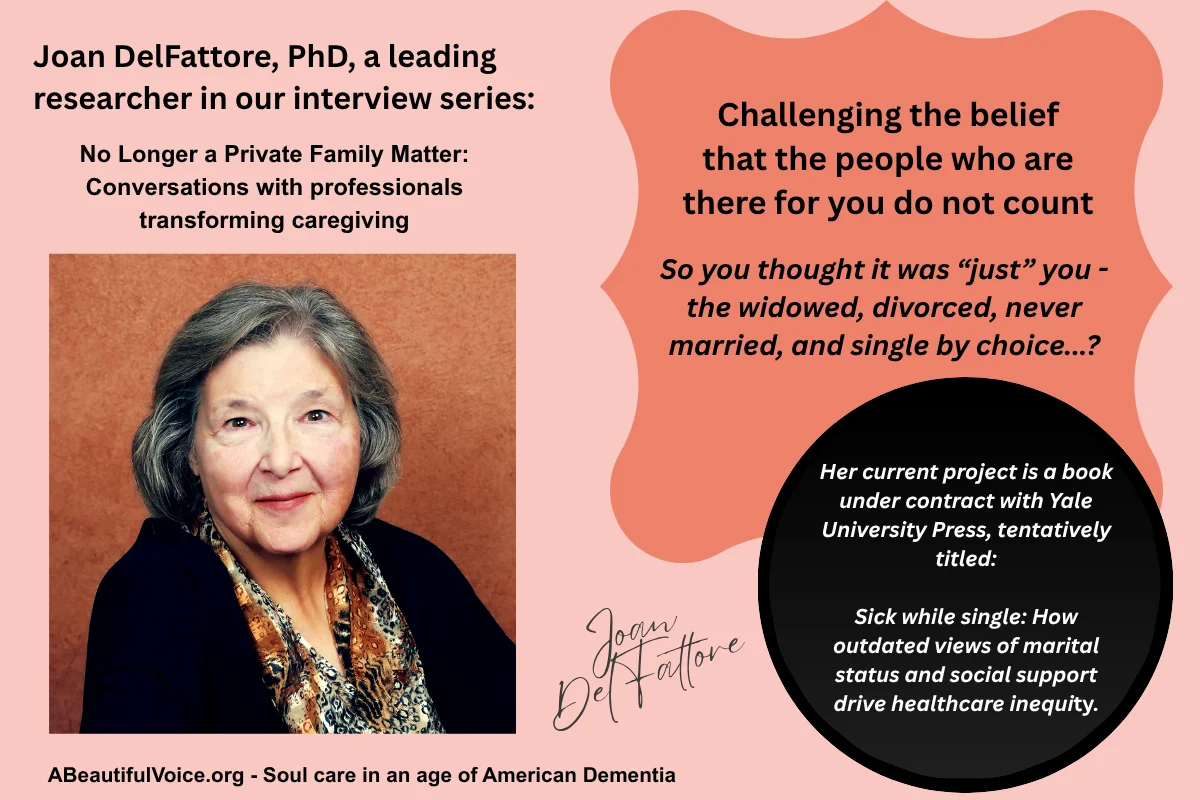
Our interview with Dr. Joan DelFattore is a must-read! From her phenomenal personal recovery to uncovering outdated and discriminatory policies directing the quality of our care, how it is provided, and by whom! This is tremendously important research on inequities in the health care system which are based on stereotypes affecting especially…
- The widowed, divorced, or never-married patient
- Those who have been a caregiver
- Those who are currently caregivers
- Those who will be caregivers
Dr. Joan DelFattore writes about improving access to American healthcare for adults who are unmarried, who do not live in traditional nuclear families, or whose families cannot provide all of the expected support. Her publications include an article in the New England Journal of Medicine showing that compared with a married cancer patient, an otherwise similar unmarried patient is significantly less likely to receive surgery or radiotherapy, although more than 98% of unmarried patients accept those interventions when offered.
Research and personal essays have also appeared in the Washington Post, Herald Tribune, Psychology Today, Health Psychologist, and many more. She gave a TedX talk, “Sick While Single Don’t Die of Discrimination,” as well as doing a podcast for Cure and an interview for All Things Considered.
Professor DelFattore’s earlier publications include three books with Yale University Press and dozens of articles, mostly about freedom of speech. Her work has won awards from the American Library Association, the American Educational Research Association, and the Spencer Foundation, among others. In addition to speaking at conferences and events throughout the country, she’s appeared on dozens of talk shows, notably 20/20, Radio Times, Fresh Air, Talk of the Nation, All Things Considered, and the Diane Rehm Show. She holds a Ph.D. in English and an M.S. in clinical psychology from Penn State University.
Her current project is a book under contract with Yale University Press, tentatively titled: Sick while single: How outdated views of marital status and social support drive healthcare inequity.
Bio republished from: Foundation for the Empowerment of Single People
__________
A Beautiful Voice Interviews Dr. Joan DelFattore: No Longer a Private Family Matter
BV: Your forthcoming book challenges assumptions that many people have never questioned. What first led you to recognize that marital status itself could become a source of inequity within health care?
JD: In 2011, I was diagnosed with stage 4 gallbladder cancer, which has a survival rate of about 3 percent. Although surgery is not generally recommended for that diagnosis, the surgeon to whom Sick While Single is dedicated took the chance of operating, which resulted in my survival. But I still needed followup chemotherapy, and an oncologist at Memorial Sloan-Kettering Cancer Center (MSK) told me that the optimal treatment was a combination of a drug called gemcitabine and a more powerful platinum drug. Because of the likely side effects, she suggested having the treatment closer to home.
The next oncologist I saw refused to provide the platinum drug because of his immovable conviction that an unmarried woman without children could not possibly have the social support necessary to handle the side effects. I returned to MSK, where I received the appropriate treatment. A few years later, the MSK oncologist who treated me led a study that identified genetic mutations that make that combination chemotherapy especially effective, and it turns out that I have three of them. If that genetic predisposition played a role in my survival, then withholding the platinum drug might have changed the outcome.
As time went by, I could not stop wondering whether the oncologist who had proposed to undertreat me was an outlier, or whether single patients, as a group, are at risk of being considered unable to handle aggressive interventions. I therefore undertook an analysis of more than 200 peer-reviewed medical articles on the relationship between marital status and cancer treatment and outcomes. Those studies showed, beyond any doubt, that unmarried cancer patients are significantly undertreated, and are more likely to die of their cancer, as compared with otherwise similar married patients. Without evidence, the authors of those studies justified this discrepancy by asserting that patients without spousal support cannot handle, and do not want, aggressive treatment. That is what led me to write articles that appeared in the New England Journal of Medicine, the Washington Post, and Psychology Today, among others, demonstrating the fallacy of that explanation. Sick While Single includes an extended discussion of that research, as well as discussions of healthcare laws and policies that discriminate on the basis of marital status.
BV: Much of the public conversation assumes that family caregiving is naturally available when illness strikes. From your research, what realities are overlooked when health care systems make that assumption?
JD: Among the many realities that are overlooked, three are especially important. First, adults who are married or who have close family nearby may not necessarily receive the level of support that is assumed to come from those ties. Close relatives may have disabilities of their own or other responsibilities that limit the caregiving they can provide, or they may simply be unable or unwilling to accept the responsibility. Conversely, single adults or those who, for whatever reason, rely on support from outside the nuclear family are not necessarily socially isolated, but may have highly effective social networks made up of extended family, friends, and neighbors. Finally, extensive sociological and psychological research shows that caregiving by people outside the patient’s immediate family is far more prevalent, and far more effective, than it is widely believed to be.
BV: Bella DePaulo has a chapter titled, “Marrieds Know Best.” It’s a remarkably concise phrase. As someone who has spent years studying healthcare inequities affecting single adults, what does that title say to you?
JD: As anyone who has read DePaulo’s work will immediately realize, that title parodies a common belief rather than endorsing it. In medical studies that compare the treatment and health outcomes of married and unmarried patients, the problem is not so much that married adults are assumed to know more, but that they are assumed to enjoy a unique, irreplaceable form of social support that is allegedly the only possible way to cope with aggressive treatment. Marriage is also viewed as a protection against such ills as depression, alcoholism, drug use, and noncompliance with medical instructions. So, in this particular body of medical literature, I wouldn’t say that marrieds are assumed to know best, but to live best. In reality, each patient’s social support system must be assessed individually, since group differences do not account for the disparities in treatment and health outcomes often attributed to them.
BV: Our interview series focuses on dementia, where families often find themselves navigating years of uncertainty rather than a single medical event. Looking through the lens of your research, are there particular ways that people who are single encounter additional barriers during a long caregiving journey?
JD: As is true in cancer care, a major problem for single individuals with dementia, and also for single individuals who wish to care for someone with dementia, is the insistence that caregiving belongs solely within the immediate family. A particularly important example is the federal Family and Medical Leave Act, which limits job-protected caregiving leave to spouses, parents, and children. Under this law, an employee who was raised by a grandmother or an aunt who now has dementia, or an employee whose sibling or cohabiting partner has dementia, could not take job-protected leave to share in the care of that individual. In addition to impeding the care of single adults with dementia, this laser focus on the nuclear family disqualifies single adults without children or living parents from taking time off from work to help anyone else, no matter how willing they are or how great the need.
The cultural conditioning underlying such laws is also harmful in itself, particularly when caregiving is so intense and extended that it requires more depth on the bench than many families can provide. Several studies of caregiving for patients with dementia show that family caregivers, particularly spouses, may be reluctant to ask for outside help because they see it a failure on their part, whereas, in reality, shared caregiving is often better for the care recipient as well as for the caregiver.
Given the need for the involvement of extended family and non-kin in long-term caregiving for persons with dementia, not only single adults, but also some families, are severely disadvantaged by cultural attitudes, laws, and policies that impede caregiving outside the immediate family.
BV: Many readers have told us they feel invisible—not because they lack commitment, but because they do not fit society’s expected picture of a caregiver. Did you encounter stories during your research that especially changed or deepened your own understanding of what it means to care for another person?
JD: For decades, research on non-family caregivers has shown a much more nuanced picture than stereotypes would suggest. Contrary to the mocking question, “If you don’t get married, are your friends going to help you take a shower if you’re sick?” the answer is often yes. As would be expected, intimate caregiving is more likely to be provided by close friends, while neighbors are more likely to run errands, offer rides, and perform such tasks as shoveling snow and mowing the lawn. As research also shows, that neighborly help, often overlooked by commentators who focus on hands-on patient care, may play a significant role in allowing older individuals to remain in their homes longer.
Sick While Single includes several vignettes showing the effectiveness of caregiving outside the nuclear family. Among other things, some of these stories contradict the needless fear caused by conditioning married couples to be so exclusively dependent on each other that if a spouse dies or is away, the remaining spouse expects to have no one to take care of them — not because they are really isolated, but because they have been taught to devalue any potential helper other than a spouse.
BV: Your work examines structural inequities rather than individual intentions. In your view, what are some of the most common ways that well-meaning healthcare systems unintentionally disadvantage people who are single?
JD: Your question refers to “unintentionally” disadvantaging single individuals, but it is not always unintentional. The fundamental design of employer health insurance plans and caregiving leave laws, for instance, dates back to the 1940s to 1960s and was deliberately designed to benefit not just nuclear families, but the specific structure of legally married breadwinner and dependent spouse. In addition to disadvantaging individuals, such policies discriminate against the Black and LGBTQ+ communities, among others, which have long relied on a more inclusive caregiving model.
Moreover, many of the policies and practices that disadvantage single adults are also detrimental to unmarried cohabiting couples and to the increasing number of families that cannot provide all of the needed care without outside help. Not surprisingly, dementia is a particularly apt example because of the heavy demands a solo caregiver may face. When healthcare personnel marginalize other caregivers or treat them as second-class, it increases the needless guilt and embarrassment that family members may feel about not being able to do everything themselves.
In answer to your specific question about how healthcare systems disadvantage single patients, examples include, among many other things, a cumbersome legal process for naming a healthcare proxy who is not the next of kin; a tendency on the part of some healthcare staff to favor family as visitors and decision-makers despite legal requirements to honor the patient’s wishes; belittling remarks from staff about patients being alone or with non-kin support persons; a lack of understanding of the need for periods of solitude; and, as mentioned earlier, the potentially life-threatening practice of undertreating single patients because of a misplaced belief in the unique importance of spousal support.
BV: If physicians, nurses, hospital administrators, and policymakers could understand just one overlooked truth about single adults and caregiving, what would you most want them to recognize?
JD: I would most want them to recognize the need to assess each patient’s support system in terms of its ability to meet the patient’s specific needs, rather than in terms of its conformity to a historically preferred nuclear family model. As an example, if an adult with dementia needs rides to medical appointments, the providers of that service need a driver’s license, not a marriage license.
BV: Public conversations about caregiving often emphasize compassion, resilience, and sacrifice. While those qualities certainly matter, are there larger cultural assumptions about marriage, family, or social support that you believe deserve much greater public examination?
JD: I think that public conversations about the need for compassion, resilience, and sacrifice in caregiving are right on target, as long as they do not assume that those qualities are to be found only in caregivers who are spouses or close family members. To be sure, family closeness and a sense of family obligation are of great value in motivating caregiving, where they exist and where the available family members are capable of handling everything on their own. But, contrary to popular belief, those are not the only possible motivations for sustained caregiving or the only basis for trust that a caregiver will, in fact, perform the needed tasks.
BV: Looking ahead, what gives you hope? As awareness grows about healthcare inequities affecting single adults, what changes—whether in medicine, public policy, or simply public understanding—would represent meaningful progress over the next decade?
JD: Several studies show that, unlike many baby boomers who grew up in the enclosed nuclear families of the 1950s, upcoming cohorts of aging adults are more open to non-kin and shared caregiving. In addition, the U.S. census bureau reports that between 2020 and 2024, the proportion of adults over 65 in the U.S. population increased by 13 percent, while the proportion of working-age adults increased by only 1.4 percent, and the proportion of children decreased by 1.7 percent. Similarly, as families grow smaller and as more adults live single and without children, the proportion of older adults who outlive all their close relatives will increase. Whether they want to or not, legislators and policy-makers are going to have to start normalizing the real-life support systems of the twenty-first century, rather than doggedly privileging the favored lifestyle of the mid-twentieth. That is particularly true when we consider the cost to taxpayers of transitioning older adults to institutional settings when they could have remained longer in their own homes if caregiving benefits were based on such factors as the needs of the care recipient and proof that the caregiver is, in fact, providing that care, rather than on degree of kinship or legally married status.
To learn more, continue here:
Connect with Dr. DelFattore here:
In her most recent message, Dr. DelFattore added this note for readers:
“I really hope that this information will be useful to the heroic caregivers for persons with dementia. I greatly admire their dedication, and I sincerely hope that some of what I’ve written might provide at least a little help.”
Posted by Susan Troyer
Founder / Author, ABeautifulVoice.org 🌿
Leave A Comment