
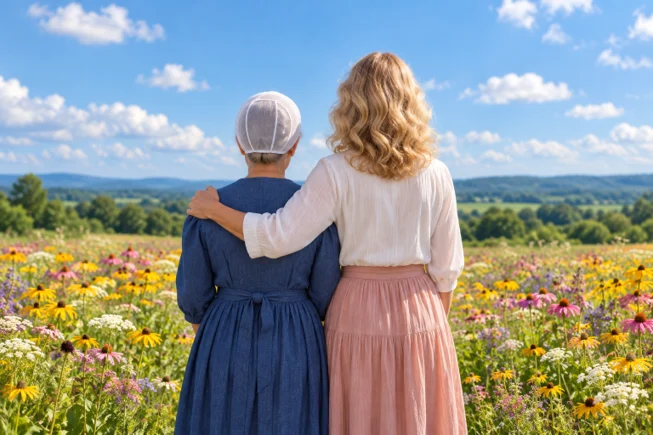
We often think that vulnerability is a kind of weakness, but there’s a kind of vulnerability that is actually strength and presence. — Ram Dass, American spiritual teacher, psychologist, and writer
It was 2005, eight years after Mother’s Alzheimer’s diagnosis, and she was still overseeing Dad’s care. Quietly present at his bedside, with our care partners and the regional hospice team standing behind her ready to do the heavy lifting. She held him close as she said to him, “I don’t know if you’ll be with us in the morning,” she told him.
She was off by only two nights.
Among those of us caring for them, a deep unspoken sense of walking on sacred ground could be felt. Barbara Hostetler was part of that circle. For ten years, she helped make it possible for us to remain together at The Ranch, as we called our home. In time, she became like a sister to me.
Vignette #1
The snowy morning we met
Our partnership began on a February morning in 2002, after a heavy snowfall had blocked the lane to Barbara’s farm. Jamie, a talented care partner who coordinated our “Dream Team,” fetched Barbara and her family and brought them to meet us.
My parents were finishing breakfast when they entered the great room of our modest home. Mother promptly announced, with authority and apparent finality, that she would not be needing any more help. They could go home!
Oh, dear. Were we about to lose them before we had even begun?
“Mother,” I explained, “if we can work this out, Barbara would be coming to help ME. I’m going to need more help so I can do my work in my office. And that’s so we can all continue to be together.”
This was a practical necessity. From our early days at The Ranch, I was contributing a third of the household expenses. Continuing my work helped make our life together possible.
“Oh, okay! That would be okay!”
She understood. Five years after her diagnosis, Mother could still recognize the importance of supporting a working daughter—especially when it impacted our lifestyle together!
On Jamie’s recommendation, we quickly arranged for Barbara’s first day. After that uncertain introduction, it soon felt as though we had always known one another. Over the years, we returned to the story of that snowy morning, laughing—and sighing—again.
Vignette #2
A seat at our table
From the beginning, Barbara prepared delicious meals from recipes we selected in our growing cookbook collection. Dad, Mother, and I ate heartily. Her family helped with our grocery shopping, delivering organic products that were beginning to appear at the Kroger store ten miles away.
Fifteen bags of groceries arrived each week. Nothing went to waste. We still had our farm appetites! Once we identified Aricept as the cause of Mother’s persistent nausea, we could again enjoy our meals together.
More than two decades later, I can still picture us at that table, savoring every bite. Those were days my parents deserved, and they embraced them with grace and gratitude.
Barbara also helped keep our small home clean and orderly. With care partners and hospice staff coming through almost every weekday, that order mattered. It helped preserve a sense of calm for all of us.
Her work touched nearly every part of our daily lives. Only later would I discover a name for a caregiving role that sounded remarkably familiar.
Vignette #3
Our royal falcon
In the Green House model of elder care, a Shahbaz is a specially trained care partner whose responsibilities extend across personal care, cooking, household tasks, and meaningful daily engagement. The work rests on knowing the people who live in the home and honoring their choices.
The name comes from a Persian word for the king’s royal falcon. When I encountered it, I smiled in recognition. We had been seeking someone to fill a role very similar at The Ranch, long before I knew the term.
Barbara was our own beloved royal falcon.
Learn more about “The Shahbaz”: Dr. Bill Thomas Describes the role of The Shahbaz
Finding that kind of care was not always easy. As I continued to search for some weekend relief, holiday coverage, and backup help, I met candidates whose understanding of caregiving had been shaped by the narrower assignments of institutional work. Our household required a willingness to move among tasks and, above all, to notice how my parents experienced the care they received.
Once, while working in my office—always with the door open—I heard Mother shrieking from the bathroom. Two new nursing assistants were talking loudly while one held a shower hose over Mother’s head as she sat on the bath bench. They seemed unaware of her distress.
I would have been shrieking, too!
We changed the approach immediately. In the years that followed, we never again heard such cries from either parent!
What mattered to me was whether someone could imagine being in my parents’ place. Credentials had their role, but empathy, attentiveness, and the willingness to respond to discomfort were essential. Those were the people we invited back.
Barbara understood this. Her diplomacy may have grown from years of caring for her own busy household, welcoming family and church visitors, and serving alongside her husband in ministry. Whatever its source, she brought a quiet assurance into our home.
On mornings when hospice staff were not scheduled, she bathed Mother and washed her hair. Then she curled Mother’s natural curly hair with her fingertips.
Together, they were beautiful to behold. It was apparent they enjoyed each other’s company. A genuine connection developed into a beautiful strong bond.
Vignette #4
A sister beside me—exuding soul care
Barbara was petite and full of energy. She reminded me of Patty Duke in Harvest of Fire. We each weighed about a hundred pounds, yet between us we managed the physical work required to care for both parents. When each became bedfast, we worked together very easily and naturally.
What Barbara offered went far beyond physical help. I now call it soul care.
We wanted to share those years with my sisters, too. Over the years, always in the spring before their summer breaks, I invited—no, I implored them—to spend time with Mother and to offer an occasional backup shift. I always offered to step away if they wanted time alone with her. The door was open. Could it have been something other than busy schedules…? Is it possible that the prevailing stigma in our culture—that she would not remember anyway—might have influenced their decisions following the diagnosis? Their absence hurt, and Mother noticed. Once, after I had explained everyone’s busy schedules again, she asked flatly but firmly, “So where are they?”
Alongside that sorrow, Barbara’s steady presence grew into a sisterly bond. She once told me she had said to her sister Gloria, then ninety-four, that talking with Susan was like talking with her. That was amusing to me—especially after Gloria accompanied Barbara to work for a full day—and I learned to know this spunky, feisty ninety-four-year-old sister! As the psychologist Ram Dass states at the top of this post, there was a sweet vulnerability in this bond that was actually strength and presence.
Laughter initiative: So, there was room in our partnership for camaraderie and laughter. Mother often ignited it. She let us know she was present, following along, and ready to join in the conversation.
One entry in our Memory Journal, dated July 28, 2005, recalls a visit to Dr. Traina after she fractured her foot. She insisted on reading his instruction sheet aloud to him. He sat back patiently and appeared to enjoy her oratorical reading.
Afterward, Barbara pushed her wheelchair through the busy waiting room of the medical office building. Mother waved a gracious, happy wave to a full reception area of people seated there, as though passing in a royal carriage. For that brief outing, she became “Our Fair Lady.”
How often does someone leave an orthopedic appointment bestowing a smiling royal wave when exiting?
Vignette #5
Faith is more precious than gold (I Peter 1:7)
Our shared faith was woven into these days. The sacred was close at hand as Barbara curled Mother’s hair, helped me lift her, or joined in another round of giggling.
Years later, a sermon by the Rev. Dr. Camille Cook Howe at my church, Fourth Presbyterian Church of Chicago, gave words to something I recognized:
“Our theology is big enough to believe God is above and beyond this life and that God is truly in the midst of this life with us as well.” Rev. Dr. Camille Cook Howe, Pastor
Barbara understood Mother’s religious upbringing. As a minister’s wife, she shared a familiarity with the world Mother had known as a preacher’s daughter. I like to think we were lifting up my mother, guiding her into the care of the angels. Quietly, gently, and so joyfully that one day as we departed the bedside together, Barbara said: “I could take care of her forever.”
“When labor leads to love, you will be given a love that will not let you go.” Rev. Dr. Camille Cook Howe, Pastor
Indeed, we were walking on sacred ground.
Vignette #6
A quiet moment of contemplation
On July 8, 2011, three weeks before Mother’s death, I recorded an unusual moment in the Memory Journal.
Barbara had finished feeding her. Instead of moving immediately to the next task, we sat on the bed, one on either side of Mother. After six months of caring for her in bed, this simple pause felt extraordinary. There was almost always something else to do to keep her comfortable. We were always in motion in our caring—some additional task was “next” and needed for her to be comfortable, even with two of us working together.
Mother looked serene, beautiful, and content. A verse from Philippians came to mind:
“For I have learned, in whatsoever state I am, therewith to be content.”—Philippians 4:11, King James Version
“That really describes your life, Mother,” I said. “The way you arrived and learned to live in the world. And now, this peace which you radiate…! It isn’t the result of an easy life.”
It felt like a small eulogy, intentionally spoken for her to hear.
I had heard those words from Philippians so many times. … But that day, sitting beside Mother with Barbara, I heard them and was moved by a new intensity and poignancy.
When I remember my parents during our years together, I remember their gratitude and determination. So much had changed, yet I continued to see them as the people I had always known. Our familiar surroundings and the love of people like Barbara helped make room for them to be themselves.
I have enough examples of Barbara’s character to fill a book. One memory, from the year before that bedside moment, tells so much.
Vignette #7
The journey home
During Mother’s nursing home stay in 2010, I received a call from the social worker on the thirteenth day. Mother had stopped eating and drinking. Such changes could happen quickly, I was told.
Only later did I learn that Barbara had gone to the nursing home to try to feed her. Mother declined to eat even then. But Barbara had gone on her own time, without being asked. She never mentioned it to me.
A few days later, she accompanied me to bring Mother home.
When I pulled the RAV up beneath the entrance canopy, Mother was radiant. She clapped, visibly elated, causing the social worker escorting her to smile too!
Mother and Barbara hugged each other all the way back to The Ranch.
That is the Barbara I want you to know: the woman who went to Mother when no one had asked her to, and who was beside her for the journey home.
I am reminded of the quote by C.S. Lewis – so descriptive of who Barbara is:
“Integrity is what you do when no one is watching.” C.S. Lewis, Author, literary scholar & lay theologian
At the end of each workday, as she departed via the front door, Barbara always left us with the same words:
“See you tomorrow—God willing!”
Vignette #8
No ordinary footnote
Barbara stayed with me for another year following Mother’s burial. While awaiting the sale of the property, she helped me sort and distribute household belongings before I returned to my home in Chicago. Our years of working side by side continued as we brought life at The Ranch to a close.
Dear Barbara,
To this Rancher, you embody so much of what it means to be fully human. Please never underestimate the gifts you have contributed. You are iconic.
Being partners with you in this venture and your ten-year ministry of love helped provide the architecture needed for Mother and Dad to be what they had always been at their core during these final years. You made our life together possible. With your help, Mother and Dad remained surrounded by the familiar comforts and relationships that mattered to them. You stood beside me in work that could be exhausting, and you shared its joy.
I think of your open heart, your clear thinking, your capable hands, your strength and endurance, and the laughter the three of us found together. I think of Mother’s curls, her royal wave, and that quiet afternoon when we finally sat down beside her.
Thank you for walking her home with me.
Jennifer Berezan’s “She Carries Me,” shared here, is for you. It holds some of the joy I felt in knowing you and being with you.
See you tomorrow—God willing!
Gratefully,
Susan
___________
YouTube links:
Jennifer Berezan’s “She Carries Me,”
Dr. Bill Thomas Describes the role of The Shahbaz
Leave A Comment