
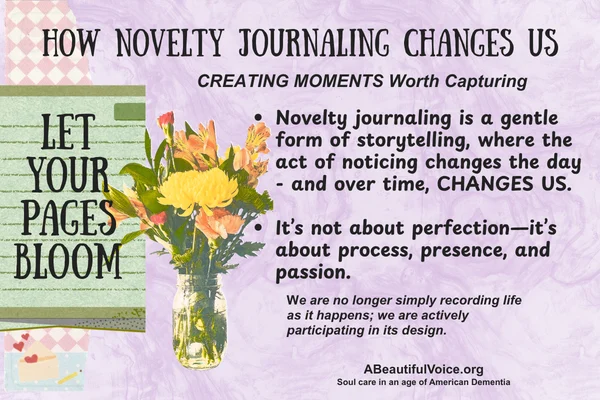
Novelty journaling is not about recording life as it happens.
It is about shaping life by paying attention differently.
Part I of The Novelty Explainer introduced the structure and philosophy behind 365 Ways to Say I Care and why it was created.
Part II turns inward—exploring how novelty journaling changes us as caregivers: neurologically, creatively, and relationally.
At its essence, novelty journaling is about creating moments worth capturing.
Not by adding more—but by noticing differently.
In caregiving, this shift is subtle but profound:
It’s not about how we “react.”
Instead of bracing for what the day may take, we begin to shape what the day might hold.
The question gently changes:
Not “What will today require?”
but “What might we offer today?”
And in that shift, the caregiver moves from responder to co-creator.
The environment softens. Attention opens. Dignity grows.
What Novelty Journaling Changes in Us
Novelty journaling does more than help us remember—it reshapes how we think, plan, and live.
Neuroscience shows that novel experiences activate brain systems linked to motivation, learning, and emotional regulation. When we intentionally seek what is new, meaningful, or slightly unexpected, we engage the brain’s capacity for flexibility and creativity.
Over time, this practice moves us out of automatic, reactive patterns and into more intentional, engaged living.
We are no longer simply recording life as it happens.
We are participating in its design.
In caregiving, this becomes transformative.
Instead of moving through a day defined by appointments, symptoms, and disruptions, we begin to orient toward possibility—toward what still delights, what still connects, what still matters.
This does not remove the realities of care.
But it changes how those realities are held.
Connection deepens. Creativity reappears.
A shared sense of purpose begins to return.
In my own caregiving journey, this shift did not just change our days—
It changed who we were becoming together.
For us at the ranch, the question became, “How can we create soulful moments of joy and delight worthy of capturing?”

2004 – Seven years following her diagnosis and three years following his diagnosis. Still enjoying each other’s company and her singing.
Preparing for Novelty Journaling
🌱 You do not need extra time, special tools, or perfect consistency to begin.
Choose one small moment each day and ask:
What might feel new, meaningful, or worthy of capturing today?
Write a sentence if you can. Hold the moment if you can’t.
🌿 This is not about doing more.
It is about bringing intention and curiosity into the life already being lived.
Even one moment of attention can begin to shift how the day unfolds—and how care is experienced.
🌼 Begin not with a notebook, but with a question.
The answer may be simple: a shared smile, a brief creative moment, a quiet pause.
Whether written or simply lived, these moments accumulate—becoming a living record of connection, presence, and care.
Over time, something subtle but meaningful occurs:
We begin to meet each day differently.
Noticing becomes habit.
Attention becomes care.
And care becomes something we actively create—one day at a time.
This is how moments become memory.
And how caregiving becomes, in its own quiet way, an act of design.
Where attention goes, care begins.
365 Ways to Say I Care | ABeautifulVoice.org
By Susan Troyer
Founder / Author, ABeautifulVoice.org 🌿

Leave A Comment