
A quiet but extraordinary moment in the neuroscience of healing
For years, journaling has often been dismissed as “just” expressive writing. But something remarkable happened recently at the end of an interview between Sanjay Gupta and Mel Robbins about chronic pain.
When asked:
“If the person listening were to do just one thing… what is the first step to take?”
Sanjay Gupta did not begin with medication.
He did not begin with surgery.
He said:
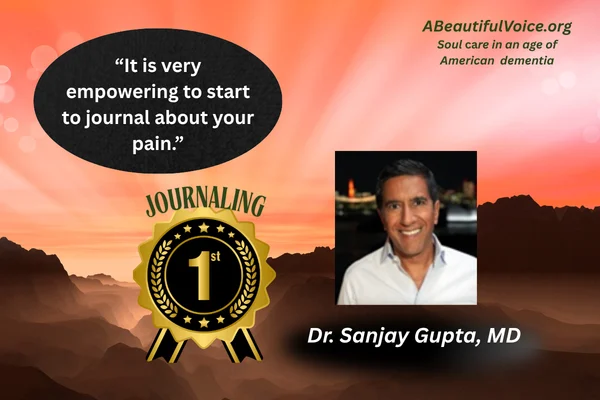
“It is very empowering to start to journal about your pain.”
And then:
“Lean into the pain.”
For those of us who spent years caregiving — searching for ways to reduce suffering, process overwhelm, and remain emotionally present — this moment lands with unusual force.
Because many of us were practicing forms of reflective writing long before neuroscience began catching up to what caregivers quietly discovered through lived experience.
At the Ranch
During my caregiving years at the ranch, Memory Journals accumulated in large binders with 3-inch spines. Read: How our simple gratitude list evolved into a “memory journal project”
One benefit derived from the Memory Journals is that each daily post served as a communication tool between the various teams who would enter on weekdays – Monday through Friday. Thus, continuity of care was promoted. The “News Center” became the hub of our planning of daily events at the table where Mother & Dad were frequently seated (close to the caregiver/chef in the kitchen) where they could also see everyone who entered the front door! Caregivers and hospice team would stop here to check the agenda and comment not only on the posted daily schedule, but also on the Memory Journals, reviewing what had happened on the previous day. Everyone was involved.
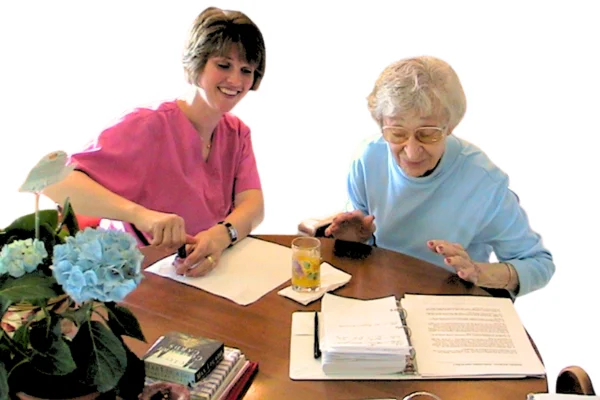
During Trish’s manicure, Miss Ethel “leans in” to read the Memory Journal entry from the previous day. Upon arriving at the breakfast table with Dad, I would find them leaning in to read the latest entry together before eating.
But interestingly, some who were not regularly present did not understand. Some who were present for only occasional brief periods regarded journaling as indulgent, unnecessary, or impractical — including a few professionals who appeared to lack awareness of the benefits.
There were dismissive smiles.
Polite remarks.
The occasional:
“Keep on journaling, Suz.”
But over time…
Neuroscience research surrounding journaling, reflection, stress regulation, and emotional processing continued to grow.
And now, hearing a nationally recognized neurosurgeon describe journaling as an empowering first step for chronic pain feels deeply validating — not only personally, but culturally.
Why This Matters
According to Sanjay Gupta, more than 50 million Americans live with chronic pain!
His broader message is not that pain is “imaginary.”
Quite the opposite.
He emphasizes that pain is real — but that the brain plays a central role in how pain is processed, amplified, interrupted, soothed, or prolonged.
That is why practices such as:
- journaling
- meditation
- pattern recognition
- emotional awareness
- movement
- nervous-system regulation
may matter far more than many people realize.
As Gupta explains:
“You are the active narrator of your pain.”
At the very end of the interview, Sanjay Gupta says quietly:
“I’m telling you — this stuff works.”
It is a simple statement.
Almost understated.
But for caregivers, chronic pain sufferers, reflective writers, and those trying to reclaim some measure of agency over suffering, it may be one of the most hopeful sentences spoken all year.
And importantly:
It positions journaling not as an idle pastime or “hobby,” but as a legitimate practice of self-regulation, healing, and meaning-making.
Where attention goes, care begins.
365 Ways to Say I Care | ABeautifulVoice.org
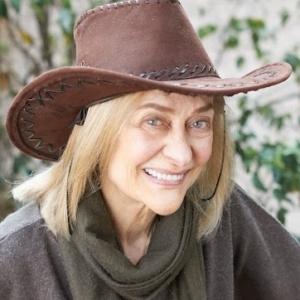
By Susan Troyer
Founder / Author, ABeautifulVoice.org 🌿
Find Mel Robbins’s interview of Dr. Gupta here:
- Feel Better Now: Neurosurgeon Reveals the New Science of Healing Your Body & Stopping Pain Today – Mel Robbins interviews Sanjay Gupta about CHRONIC PAIN.
Read more about our experience with JOURNALING at the ranch – and how it has grown into a practice we now call Novelty Journaling:
- Reading and journaling were an important part of our time together
- Journaling benefits – a voyage to the interior
- Why I journaled – Journaling is a powerful tool which can be life-changing
- 365 Ways to Say I Care: The NOVELTY EXPLAINER – Part I: What This Is
- 365 Ways to Say I Care: The NOVELTY EXPLAINER – Part II: How Novelty Journaling Changes Us
Leave A Comment