
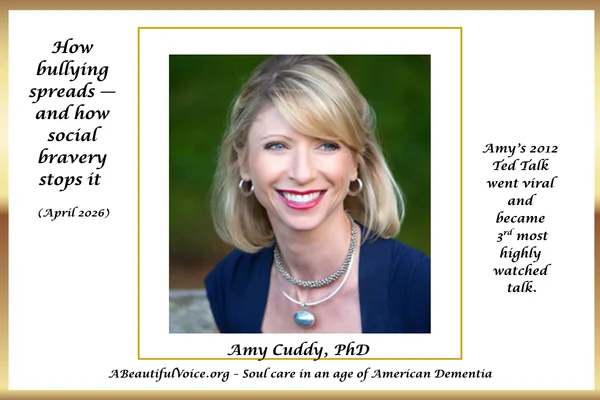
“Bullying – the act of harassing, intimidating, or abusing others, especially habitually or from a perceived position of relative power.” – Dictionary.com
In Amy’s words…
“… this kind of bullying is simultaneously this horrible public spectacle of shame where you’re in a spotlight. And at the same time, it’s a total erasure of who you are and what you’ve done. Many targets don’t survive. And I do want to say, before I go forward, to the targets: I understand. I see you, and I know that what seems incredible – It happened.
“… it’s intended to destroy a person’s reputation and their ability to contribute. It unfolds in predictable stages. And it usually ends with someone being completely silenced or disappearing completely. So … What do we do? The first thing to understand is that bullies need us. Bullies need an audience.”
Why Amy’s story may resonate with caregivers
Google was officially launched as a company in late 1998. It was just as I was arriving back in my hometown to support my parents through this new life stage following my father’s distress call for help.
During this period of early online research, I was seeking anything related to the mantra which kept resonating deeply within me. The mantra: “It’s about dignity.” My premonition was that this mantra would become significant during my stay. How could I have known that several decades later, these words would still be helping me to stay grounded and aligned with my core values?
Gerontological research heavily documented this phenomenon in the late 1990s: When an aging parent requires help, families typically default to one of two pathways: cooperation and criticism. Decades later, today’s research shows that these dynamics haven’t changed.
At that time, family sociologists and healthcare professionals also observed that when a parent faces a crisis such as cancer, heart, stroke, respiratory, families often rally together. In contrast, dementia and cognitive decline create unique psychological strains in family systems.
So I have been well-aware of these phenomena for several decades. Family criticism is not a new phenomenon. And according to my thesaurus, bullying was first recorded in 1675–85.
After reviewing Amy’s Ted talk several times, I am deeply saddened by the attempts at targeted erasure of who she is, her gifts, her contributions, her many accomplishments. … Those attempts were intended to destroy her reputation.
Indeed, she left! … Silenced – one year before tenure at Harvard.
But what a phenomenonal inspiration she is: Dr. Amy J.C. Cuddy.
When a Caregiver Becomes the Target
What Amy Cuddy’s talk on bullying and social bravery brought back to me
When a parent is living with dementia, a family caregiver may be managing daily care while also communicating with the carer team, family, relatives, professionals, and institutions. Disagreement is part of many families’ lives. But when criticism becomes persistent, when a caregiver’s account is dismissed, or when others quietly stand by, the harm can reach far beyond a disagreement about care.
Social psychologist Amy Cuddy’s TED talk, How bullying spreads—and how social bravery stops it, gave me a word I find especially useful: target. It names a person’s position in a harmful pattern without asking us to diagnose anyone else.
As I listened, I remembered Miss Robinson, my sixth grade teacher. One day at recess, several of us witnessed a classmate being treated cruelly. Back in the classroom, we were in for “The Talk.” Miss Robinson told us that those of us who had watched were part of what had happened. I have remembered her words all these decades later.
Her lesson still prompts a difficult question: What can I do when I see someone being diminished?
I have asked that question throughout my years in dementia care. My guiding words from the day I returned to my hometown were, and remain, “It’s about dignity.” That means dignity for the person living with dementia. It also means listening seriously to the caregiver whose work, judgment, and contributions may be questioned or overlooked.
“Imagine someone you trust not speaking up for you in a moment of injustice, because speaking up would cost them something.” (Oprah)
Amy Cuddy calls on people around a target to practice social bravery. For a caregiver, that might begin with someone willing to listen, asking what has happened, and, most importantly, speaking up when the caregiver’s account is dismissed.
Those acts cannot resolve every troubled family relationship. They can, however, disrupt the silence that lets harm continue.
Caregivers deserve people who will stand beside them. I want to make more room for that conversation here.
Watch Amy Cuddy’s TED talk: How bullying spreads—and how social bravery stops it … See full transcript here
Photo Attribution: Photo by Evgenia Eliseeva: Portrait of Amy J.C. Cuddy. Source: Wikimedia Commons – Acuddy.jpg
Author:

Member:
Thank you for this, Susan. The line about the caregiver being the target really stayed with me. One thing I have learned building privacy-first home sensing is that the criticism almost never starts with malice. It starts with distance. The sibling who lives far away criticizes the care plan, while the one in the house absorbs every hour of the reality. The far-away sibling is not seeing the same days.
Your Miss Robinson story is the right antidote. The people around the caregiver are the whole ballgame. I would add one more form of social bravery that I have seen matter: believing the caregiver’s account of what a day actually costs. Criticism dissolves pretty fast once someone has sat through one full day.
Thank you for writing so clearly about this.
Thank you, Alex, for your thoughtful reply and the ideas you shared. It means a lot. :)