
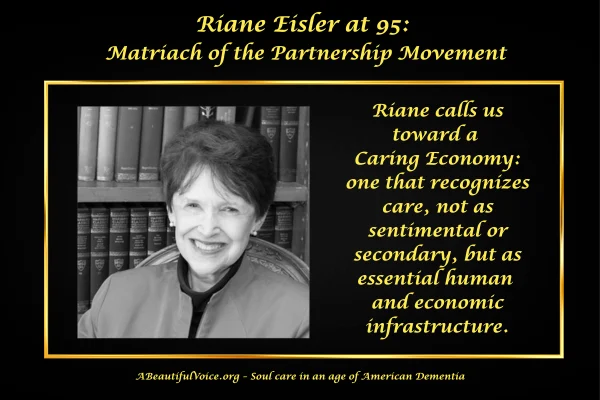
At 95, Riane Eisler remains actively engaged in the work she has pursued across a lifetime: helping humanity move from systems of domination toward systems of partnership.
Her recent online program, Peace Begins at Home, brought together more than 2,000 registered participants around a principle that reaches far beyond the household. What happens within families is shaped by the values, policies, and economic systems surrounding them—and what society dismisses as “private” may reveal some of its deepest public failures.
I studied with Riane in a small-group online course in 2014. My respect for her work has only deepened since then. Few thinkers have spoken more clearly for women, caregivers, children, older people, and all those whose wellbeing depends upon work that our economy routinely overlooks or undervalues.
Riane calls us toward a Caring Economy: one that recognizes care not as sentimental or secondary, but as essential human and economic infrastructure.
Her work offers precisely the framework we need for confronting another crisis still treated too narrowly as a medical matter: the overmedication of mental health.
The question becomes: Why have decades of knowledge failed to produce system-wide change—and why are families still privately absorbing the consequences?
When the Prescription Follows the Patient Home
A recent video by caregiving researcher Neal K. Shah brought me back to three articles I commissioned in 2015 for the website of my physician consulting business: “Stress and Women: An American Epidemic” and the two-part “Women, Dependency and Overprescribing.”
Those articles were addressed primarily to physicians. Yet the questions they raised were not abstract to me. By then, I had already witnessed how readily distress—particularly women’s distress—could be medicalized, and how profoundly the after-effects could reach beyond one patient. A prescribing decision occurs in a medical office, but its consequences may enter the home, alter relationships, and leave emotional scars across an entire family.
Neal’s video, “Three Women—One HIDDEN Link,” calls renewed attention to what he describes as the overmedication of mental health. I am grateful that he has a megaphone and is using it. But the problem itself is not hidden—and it is not newly discovered.
For decades, physicians, researchers, authors, patients, and families have warned about the medicalization of ordinary human distress, the risks of long-term medication without adequate review, and the harm that can occur when chemical intervention substitutes for sustained human care.

Medication can be life-saving and essential. This is not an argument against appropriate treatment, nor is it an indictment of every physician who writes a prescription. It is an argument against a system that gives both physicians and patients too little time: too little time to hear the full story, explore non-drug supports, discuss risks and benefits, monitor long-term effects, or reconsider medications when circumstances change.
A fifteen-minute appointment may be efficient for the institution, but human distress rarely arrives in a form that can be responsibly understood in fifteen minutes. Under those conditions, even conscientious physicians may be pressured to offer the one intervention the system is prepared to reimburse: a prescription.
My parents experienced this pattern before I returned home to support and facilitate them in their medical visits. Both had accumulated medications prescribed by good doctors responding to individual office visits. Yet no one appeared responsible for stepping back and asking what the medications were doing collectively—or whether they were still helping. The responsibility for observing, questioning, and managing the consequences eventually shifted to me as the family caregiver.
No longer a private family matter
The healthcare decision may be made professionally, but much of its aftermath is managed privately: by the mother watching her child change, the daughter trying to understand an aging parent’s confusion, or the caregiver attempting to distinguish illness from adverse effects, interactions, or withdrawal. Families become the unpaid monitors of a system they did not design.
Riane Eisler’s work on Caring Economics offers a larger framework for imagining something different. A caring economy would not measure success merely by the number of patients processed, appointments completed, or prescriptions filled. It would value time, attentive relationships, prevention, caregiver knowledge, shared decision-making, and the life-sustaining work performed within families.

The warning signs have been visible for years. What remains missing is not awareness alone, but the political and institutional will to act. That means payment reform, longer and more humane clinical encounters, meaningful medication review, greater access to non-drug support, and public leadership that treats mental health—and women’s health—as priorities.
Peace begins at home. And public systems help determine what families must confront when they get there.
The call for partnership is both visionary and urgently practical
Riane Eisler has spent a lifetime teaching that peace begins at home—but she has never suggested that responsibility ends there. Homes do not exist apart from public policy, economic priorities, healthcare systems, or cultural attitudes about whose lives and labor matter.
When rushed medical decisions follow patients home, families become the unpaid monitors and caregivers become the private responders to public-system failures.
That is why overmedication for everyday life struggles is no longer a private family matter. And it is why Riane’s call for partnership is not merely visionary. It is urgently practical.
At 95, the Matriarch of the Partnership Movement is still showing us another way.
Author:

Leave A Comment